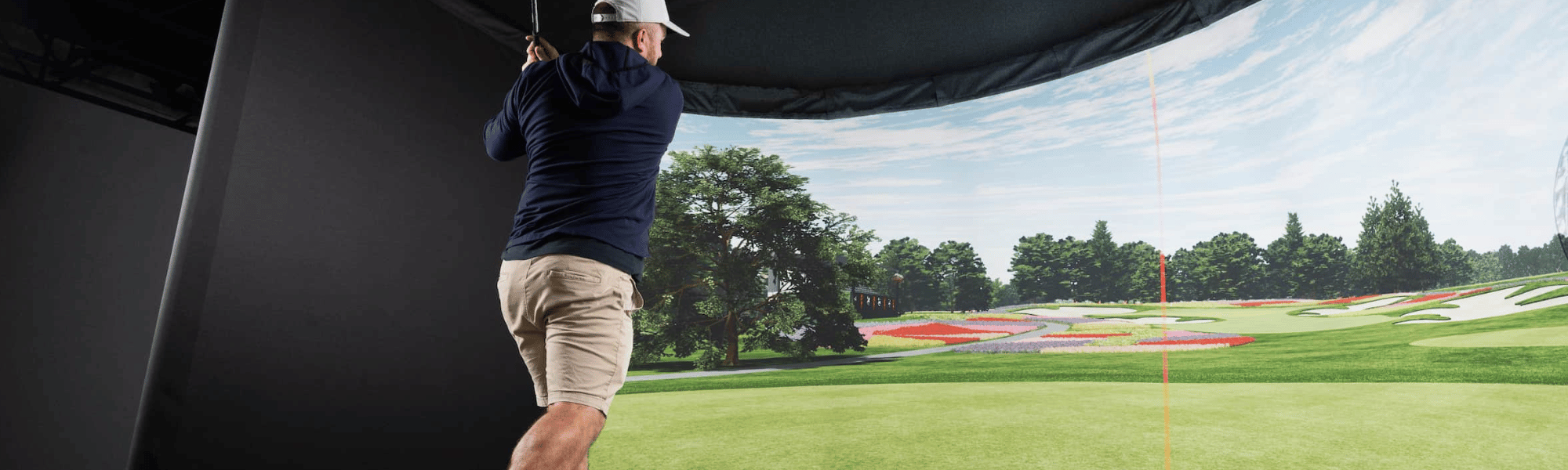

You just got a launch monitor. You hit a 7-iron. The screen fills with numbers: ball speed 132, launch angle 17.4, spin rate 6,280, smash factor 1.42, attack angle -3.7. Cool. What does any of that mean?
Launch monitors measure what happens at the moment the club meets the ball — and then calculate what happens after. Each metric tells a different piece of the story: how fast, how high, how much spin, which direction, and how far. Together, they paint a complete picture of your swing that no eyeball or "feel" can replicate.
This guide explains every common launch monitor metric in plain English: what it measures, why it matters, and what good numbers look like. Whether you're using a $700 Rapsodo or a $6,500 ProTee VX, the data means the same thing — and knowing how to read it is the difference between "I hit the ball" and "I understand my ball flight."
Jump To A Section
Ball Data: What Happens to the Ball
These metrics describe the ball's behavior at and immediately after impact. Ball data is what every launch monitor measures — it's the foundation.
Ball Speed
Measured in: MPHThe speed of the golf ball immediately after impact. This is the single biggest determinant of how far the ball will travel. More ball speed = more distance, all else being equal.
Ball speed is a function of club speed and how well you strike the ball (center contact). You can swing fast but if you hit it off the toe, your ball speed suffers.
Launch Angle
Measured in: Degrees (°)The vertical angle the ball leaves the clubface — how high or low it launches relative to the ground. A low launch angle means a penetrating, boring trajectory. A high launch angle means a towering shot.
Optimal launch angle depends on the club. Driver launch should generally be higher than most amateurs think (12–15°), while irons should launch lower and rely on spin to hold their trajectory.
Spin Rate (Total Spin)
Measured in: RPM (revolutions per minute)How fast the ball is spinning after impact. Spin is what makes the ball climb in the air, hold a line, and stop on the green. Too much spin on a driver creates a balloon shot that goes high but not far. Too little spin on an iron produces a knuckleball that won't hold the green.
Spin rate is one of the most important metrics for diagnosing distance loss. Many amateurs spin their driver 3,000+ RPM when optimal is closer to 2,000–2,500 RPM.
Back Spin & Side Spin
Measured in: RPMBack spin is the component of total spin that makes the ball climb and stop. Side spin is the component that makes the ball curve left or right. Some monitors report these as separate numbers; others report total spin plus a spin axis angle (which tells you the same thing in a different format).
Side spin is what creates draws and fades. A ball with 500 RPM of right side spin will fade. A ball with 1,500 RPM of right side spin will slice. Reducing unwanted side spin is one of the fastest ways to straighten your ball flight.
Spin Axis
Measured in: Degrees (°)Think of spin axis as the "tilt" of the ball's spin. A spin axis of 0° means pure backspin — the ball flies straight. A positive spin axis tilts right (fade/slice for a right-handed golfer). A negative spin axis tilts left (draw/hook).
Spin axis is the more technically accurate way to express what "side spin" describes. Some monitors report one, some report the other, some report both. They're telling you the same thing: which way the ball is curving and how much.
Launch Direction (Side Angle)
Measured in: Degrees (°)The horizontal direction the ball starts relative to the target line — how far left or right of the target the ball launches. This is separate from where the ball ends up (which is also affected by spin). A ball can start 3° right of target and draw back to center, or start 3° right and slice further right.
Launch direction is primarily influenced by face angle at impact. Where the ball starts is where the face is pointing. Where the ball curves is determined by the difference between face angle and club path.
Club Data: What the Club Is Doing
Club data describes how the club is delivered to the ball. This is where swing improvement lives — because you can't change what the ball does without changing what the club does. Not all monitors measure these directly; some estimate them from ball data using algorithms.
Club Speed (Club Head Speed)
Measured in: MPHThe speed of the clubhead at the moment of impact. This is the engine of your distance — faster club speed creates faster ball speed, which creates more distance. But only if you make center contact.
Club speed is the metric most golfers obsess over, and for good reason. Every additional MPH of club speed is worth roughly 2.5 yards of carry with a driver (assuming solid contact). But chasing speed at the expense of contact quality is a losing trade.
Smash Factor
Measured as: Ratio (ball speed ÷ club speed)Smash factor measures the efficiency of the energy transfer from club to ball. It's calculated by dividing ball speed by club speed. A higher smash factor means you're getting more ball speed out of the same swing speed — in other words, you're hitting it more solidly.
The theoretical maximum with a driver is about 1.50. If your smash factor is significantly below 1.45 with a driver, you're losing distance to off-center contact, not to a lack of swing speed.
Club Path (Swing Path)
Measured in: Degrees (°)The horizontal direction the club head is traveling at impact, relative to the target line. A positive club path means the club is moving to the right of target (in-to-out for a right-handed golfer). A negative path means the club is moving left of target (out-to-in).
Club path is one half of the equation that determines shot shape. The relationship between club path and face angle is what creates draws, fades, hooks, and slices. A path of 0° with a face angle of 0° = straight. A path of +3° with a face angle of +1° = draw.
Face Angle
Measured in: Degrees (°)The direction the clubface is pointing at impact relative to the target line. Face angle is the primary determinant of where the ball starts. In modern ball-flight laws, the ball launches approximately 70–80% in the direction the face is pointing, with the remaining influence coming from club path.
If your face is 5° open at impact, the ball will start right — regardless of what your path is doing. Controlling face angle is the single most impactful skill for controlling ball direction.
Face to Path
Measured in: Degrees (°)The difference between face angle and club path. This is the metric that determines shot curvature — whether the ball draws, fades, or flies straight. A face that is closed relative to the path creates draw spin. A face that is open relative to the path creates fade spin.
If your face to path is 0°, the ball will fly straight (or at least with no intentional curve). Every degree of face-to-path difference creates more sidespin. Most tour players maintain face-to-path within ±2° to ±4° of their intended shot shape.
Angle of Attack (Attack Angle)
Measured in: Degrees (°)The vertical angle the clubhead is moving at impact — whether it's traveling upward (positive) or downward (negative) through the ball. With a driver, you want a slightly positive angle of attack (hitting up on the ball) to launch it higher with less spin. With irons, you want a negative angle of attack (hitting down on the ball) to compress it and create spin.
Angle of attack is one of the most important metrics for optimizing driver distance. Many amateurs hit down on their driver (-3° to -5°), which creates too much spin and kills distance. Changing from -3° to +3° with the same swing speed can add 20–30 yards.
Dynamic Loft
Measured in: Degrees (°)The actual loft of the clubface at impact — which is different from the static loft number stamped on the club. A 7-iron might be stamped 30° but deliver 24° of dynamic loft if you're pressing the handle forward (delofting) at impact. Or it might deliver 34° if you're flipping the club and adding loft.
Dynamic loft is what actually determines launch angle and spin, not the number on the club. It's the combination of the static loft, how much you lean the shaft at impact, and your angle of attack. This metric is essential for club fitting and understanding why your distances don't match what the loft chart says.
Impact Location (Strike Point)
Measured as: Position on clubface (horizontal & vertical)Where on the clubface the ball makes contact — high, low, toe, heel, center. Off-center hits reduce ball speed (lower smash factor), change spin characteristics, and send the ball in unintended directions. A toe hit tends to produce a draw; a heel hit tends to produce a fade.
Impact location is displayed as a dot or heat map on the clubface. Consistent center contact is the hallmark of a skilled golfer — and it's the fastest path to more distance without swinging harder.
Trajectory & Distance Data: Where the Ball Goes
These metrics are typically calculated from ball data (speed, launch, spin) rather than directly measured. They describe the full ball flight and final outcome. Some monitors — especially radar-based ones used outdoors — can track actual ball flight. Indoors, these numbers are always calculated.
Carry Distance
Measured in: YardsHow far the ball travels through the air before it first touches the ground. This is the distance metric that matters most for approach shots and course management — because carry determines whether you clear the bunker, reach the green, or fly over the back.
Total Distance
Measured in: YardsCarry plus roll after landing. This is the total ground distance the ball covers. Total distance depends heavily on ground conditions — a firm, dry fairway gives much more roll than a soft, wet one. Launch monitors calculate roll based on standard conditions, so take the "total" number as an estimate.
Apex (Max Height)
Measured in: Feet or YardsThe highest point of the ball's trajectory. Higher apex generally means a steeper landing angle, which helps the ball stop faster on the green. A lower apex means a more penetrating flight that rolls more after landing. Apex is influenced by launch angle and spin rate together.
Landing Angle (Descent Angle)
Measured in: Degrees (°)The angle at which the ball hits the ground. A steeper landing angle means the ball stops faster. A shallow landing angle means more rollout. For approach shots, you generally want a steeper descent to control where the ball ends up.
Hang Time (Air Time)
Measured in: SecondsHow long the ball is in the air. Longer hang time generally correlates with higher shots and more carry, but extreme hang time (a pop-up or skyball) means you've launched too high with too much spin and the ball isn't going as far as it could.
Offline
Measured in: Yards (left/right of target)How far left or right of the target line the ball finishes. This is the end-result accuracy metric — it combines the effects of launch direction, spin axis, and wind (if measured outdoors). Indoor simulators calculate offline from launch conditions.
Benchmark Numbers: What "Good" Looks Like
These are general benchmarks for a driver. Your numbers will vary based on club, swing speed, and skill level — but this gives you a reference point for evaluating your data.
| Metric | Average Amateur | Good Amateur | Tour Level |
|---|---|---|---|
| Club Speed | 85–95 MPH | 95–105 MPH | 110–125 MPH |
| Ball Speed | 125–140 MPH | 140–155 MPH | 165–185 MPH |
| Smash Factor | 1.38–1.44 | 1.44–1.48 | 1.48–1.50 |
| Launch Angle | 9–14° | 11–14° | 10–13° |
| Spin Rate | 2,800–3,500 RPM | 2,200–2,800 RPM | 2,000–2,600 RPM |
| Angle of Attack | -2° to -5° (down) | 0° to +3° (up) | +1° to +5° (up) |
| Carry | 195–220 yds | 225–255 yds | 275–305 yds |
Which Metrics Should You Focus On?
You don't need to monitor all 24 data points on every swing. Focus on the metrics that match what you're trying to improve:
If you want more distance: Watch ball speed, smash factor, angle of attack, and spin rate. The fastest path to more yards is usually improving contact quality (smash factor), optimizing attack angle with driver (hitting up instead of down), and reducing excess spin.
If you want straighter shots: Watch face angle, club path, and face-to-path. Your slice is created by an open face relative to your path. Fix one or both, and the ball flight straightens out. Spin axis will confirm whether you're making progress.
If you want better iron play: Watch launch angle, spin rate, and landing angle. Good iron players launch lower with more spin, which creates a steeper descent angle and helps the ball stop on the green. If your 7-iron launches 25° with 4,500 RPM spin, you're flipping the club — and the ball is landing flat and rolling forever.
If you're getting fit for clubs: Every metric matters, but pay special attention to dynamic loft, attack angle, spin rate, and ball speed across your set. These tell a club fitter exactly what shaft flex, loft, and head design will optimize your launch conditions.
Data Points by Launch Monitor
Not all monitors measure the same metrics. Here's what you get with the monitors we carry:
| Metric | MLM2Pro | Spica 3 | VTrack | ProTee VX | Garmin R50 |
|---|---|---|---|---|---|
| Ball Speed | ✓ | ✓ | ✓ | ✓ | ✓ |
| Launch Angle | ✓ | ✓ | ✓ | ✓ | ✓ |
| Spin Rate | ✓ | ✓ | ✓ | ✓ | ✓ |
| Spin Axis | ✓ | ✓ | ✓ | ✓ | ✓ |
| Club Speed | ✓ | ✓ | ✓ | ✓ | ✓ |
| Smash Factor | ✓ | ✓ | ✓ | ✓ | ✓ |
| Club Path | — | ✓ | ✓ | ✓ | ✓* |
| Face Angle | — | — | ✓ | ✓ | ✓* |
| Face to Path | — | — | ✓ | ✓ | — |
| Angle of Attack | — | ✓ | ✓ | ✓ | — |
| Dynamic Loft | — | — | ✓ | ✓ | — |
| Impact Location | — | — | ✓ | ✓ | ✓* |
| Carry / Total | ✓ | ✓ | ✓ | ✓ | ✓ |
| Total Data Points | 14+ | 27 | 24 | 24 | 15+ |
| Price | ~$699 | $3,199 | $5,000 | $6,500 | $4,999 |
* R50 requires included club stickers for certain club metrics.
The pattern is clear: as you move up in price, you get more club delivery data. Ball data (speed, spin, launch) is available on everything. Club path, face angle, attack angle, and impact location are the metrics that differentiate mid-range monitors from premium ones — and they're the metrics that instructors and serious improvers rely on most.
📋 The Bottom Line
Launch monitor data isn't complicated — it's just a lot of numbers hitting you at once. Start with ball speed, carry distance, and spin rate to understand your baseline. Add smash factor and attack angle to optimize your distance. Then dig into club path, face angle, and face-to-path when you're ready to shape your shots and work with an instructor.
The data is only useful if you know what you're looking at. Now you do.
Browse Launch Monitors → Best Golf Simulators 2026 →Frequently Asked Questions
What's the most important launch monitor number?
For distance: ball speed. For accuracy: face angle relative to club path. For overall game improvement: smash factor, because it tells you how efficiently you're converting swing speed into ball speed. A high smash factor means center contact, which means everything else improves — distance, accuracy, consistency.
Why are my distances different on a launch monitor than on the course?
Launch monitors calculate carry and total distance based on standard atmospheric conditions (sea level, 70°F, no wind). On the course, altitude, temperature, humidity, wind, and ground firmness all affect actual distance. A ball carries further in Denver than in Miami, further in summer than winter, and further downwind than into the wind. Use your launch monitor numbers as a consistent baseline, not a course prediction.
What's a good smash factor?
With a driver, anything above 1.45 is solid. The theoretical maximum is about 1.50 (limited by the coefficient of restitution rules). If you're at 1.40 or below with your driver, you're losing significant distance to off-center contact. With irons, good smash factor ranges from 1.30–1.38 depending on the club.
Should I hit up on my driver?
Almost certainly yes, unless you're a tour player with an intentionally low, penetrating driver flight. Most amateurs hit down on their driver (negative angle of attack), which adds spin and costs distance. Moving from -3° to +3° with the same swing speed and center contact can easily add 15–25 yards of carry by reducing spin from 3,000+ RPM to 2,200–2,500 RPM.
What's the difference between "measured" and "calculated" data?
Measured data is captured directly by the cameras or radar at impact — things like ball speed, launch angle, and spin. Calculated data is computed from measured data using physics models — things like carry distance, apex height, and landing angle. Indoor simulators always calculate trajectory data since the ball hits a screen before completing its flight. Both types are useful and accurate, but measured data is generally considered more reliable.
Do I need all 24 data points to improve?
No. Ball speed, launch angle, spin rate, carry distance, and smash factor will get you 80% of the way there. The additional club metrics (path, face angle, attack angle, dynamic loft) become important when you're working on specific swing changes, fitting clubs, or trying to shape shots intentionally. More data is better, but don't let data overwhelm actually hitting balls.